A bit of data on the income stagnation and related arguments

The main difficulties I have with the “falling incomes” argument is that the country has changed dramatically over the past few generations and people are often unclear about what they mean by this.

Here are just some of the key changes/issues:

  • Women constitute a larger proportion of the workforce than they once did
  • Minorities, especially latinos, comprise a larger share of the population (households, families, tax units, etc)
  • Families (and thus households) are substantially smaller than before because younger generations are less likely to get and stay married and because they have fewer children when they do.
  • There has been a marked increase in education credential attainment.  Comparing a HS (only) grad from 1960 to 2015 doesn’t make much sense.
  • Some subgroups have changed their workforce participation behavior dramatically over the past few decades

Thus when we talk about directional changes in income it’s important to understand what we are actually concerned with.  Is it more along the lines of “the same groups in the same job working the same number of hours are earning less in real dollars” (i.e., people are getting paid less for the same sorts of efforts) or is it a broader statement like “households have less income than they did generations ago” (regardless of work, household size, race/ethnicity, gender, etc)?   The latter category is much easier to argue than the former.

On school quality, test scores, and SES

I am going to share a little analysis I’ve done by combining Pennsylvania’s PSSA test scores, Census ACS data,  and Department of Education statistics to refute a few popular progressive notions about education, namely, that:

1: The SAT/ACT only “measures family income”:

SAT_scores_by_income

2: This is somehow being caused by more and better test prep efforts amongst the more affluent.

3: Higher income school districts are actually better because they spend more money.

Understanding the academic achievement gaps

Warning: This is long somewhat meandering post and a work-in-progress

My intent here was to compile the evidence in a narrative fashion.  There are more detailed and more technical sources for much of the information I presented here, but much of it is scattered and much of it is targeted at people that are both knowledgable and willing to invest the time.  My approach here was to present the information in a relatively accessible, top-down fashion, i.e., first identify the magnitude of problem, then characterize it, then present evidence that the favored environmental explanations do not add up, and then (briefly) touch upon some more controversial hypotheses….

One of the first things that clued me into the fact that school systems and socioeconomic status cannot explain the black-white (B-W) academic achievement gaps was seeing SAT data like this:

sat race income 2003

sat race education 1995

sat race income 1995

satracialgapfigure

The obvious pattern here is that high socioeconomic status (SES) blacks do no better (and often worse) than low SES whites, whether measured by their parents’ income or their parents’ educational credentials.   This is really hard to explain away as being mainly a product of poverty, bad schools, and things of that sort either.

On the popularly reported black implicit association test (IAT) results

Recently the media and various friends and family have been asserting that implicit association tests (IAT) “prove” that whites are biased against blacks and that this presumably substantially explains the racial disparities in police shootings.

Race_630_Racist2

Since I am skeptical about the racial angle in police shooting, the validity of measures like IATs, and of received wisdom in general, I thought I would take a look at “Project Implicit” to better understand it.  The raw data for these results is available in SPSS format on OSF.io (albeit at >2GB) so I downloaded the data and performed some analysis in R.

A brief post on racial disparities in officer involved shootings

I have recently heard it said that the reason the police shoot blacks, especially young black men, at such a disproportionate rate is because they have an irrational fear of them because they are black.   Presumably the proponents of this view believe that shootings, “justifiable” or otherwise, should happen in roughly equal proportion to their share of population.  Although I do not believe the police are incapable of excessive force, racial discrimination, negligence, or what have you, the presumption that such disparities must be explained by presumed irrational fear of blacks strikes me as terribly naive on several levels.

Robert VerBruggen of RealClearPolicy did an interesting post on “Race, Age, and Police Killings” a few weeks back that compared nation-wide homicide rates by age group and race to the police shooting statistics.


rcp_white_black_homicide_offenders rcp_whites_blacks_killed_by_age

white_black_homicide_to_shootings_ratio

I thought this was a good and fair way to better illuminate the “fairness” issues here, since groups (e.g., sex, age, race, ethnicity, education, etc) that commit more murder (and other violent crimes) nationally can be reasonably assumed to be more likely to have confrontations with police and more violent confrontations when they do.

I found some data to take this point further by looking more granularly at the demographics of offenders that have actually killed law enforcement and offenders that have assaulted and seriously injured the police (as in with guns, knives, etc).  This data gives us a much better sense for the risks posed by each groups to the police and which groups are relatively more likely to be be confrontational, disobey, or even resort to violence, i.e., it speaks much more directly to the dynamics of police encounters with particular demographics (to the extent that one can argue that, say, national homicide rates are only black-on-black, gang-on-gang, or some such).  Most police encounters do not result in death of either party or even an exchange of gun fire, but groups that kill, injure, or assault the police at (much) higher rates can be reasonably presumed to be at (much) higher risk of getting killed by the police, “justifiable” or otherwise.

Some visualizations of ancestry.com’s genetic data

As a quick follow up to my earlier post using ancestry.com’s “Genetic Census of America”, I thought I’d post some more heat maps using the data I aggregated by major continental group (“race”) and by the more granular “adjusted” European ethnicities (i.e., whereby I simply divide the ethnicity by the total european “ethnicities” in the state).

Note: You can click these images for an interactive view to see the actual numbers for each state if you care.

Adjusted European Ethnicities

Google Chrome (8)


United States taxation compared to various European countries

It is well established that the United States has a much lower average tax burden than Europe (broadly).

Tax Revenue as Percentage of GDP OECD comparison

source: OECD Tax Database

However, some people seem to believe that ordinary people in Europe do not actually have to pay much higher taxes and that somehow (illogically) these countries with presumably lower income inequality are able to generate all of this tax revenue to pay for all this “free” stuff by just taxing the top 5% or some such.  This is complete nonsense!  These European countries generate this revenue, in the main, with a much broader tax base, both income and social security taxes (and consumption taxes to lesser extent).

Below are a bunch of graphs and figures produced from the OECD’s estimates from the statutory tax code (note: these are particularly sensitive to assumptions made)

National Healthcare Expenditure: United States versus Other Countries: The US is not really an outlier.

UPDATE (9/25/2016): I just created a new and (hopefully) much improved version of this argument here.  I suggest you start there instead.

Numerous people have asserted that the United States spends dramatically more on healthcare than other countries, presumably even more than countries of our level of wealth and affluence, and that this can only be explained by the fact that we do not have single-payer or some such.

Here are some examples graphs used to make this point

Above-expected-500x406 (1)

health-care-spending-in-the-united-states-selected-oecd-countries_chart02

These appear to be very convincing at first blush, but i never found these arguments particularly convincing due primarily to:

  1. Imperfect comparability between the selected countries
  2. Issues relating to comparing countries of the “same” GDP
  3. cherry-picking of countries

I knew the proponents of single-payer were, at best, making an incomplete argument and that it invited an exaggerated impression of what we should likely expect from a country like ours, but, up until now, I lacked the data and the time to present these argument comprehensively.  I recently got in an argument with someone over this subject and found a treasure trove of data all in one place (mostly) to thoroughly debunk this overly simplistic argument.

To make my points, vis-a-vis fundamental issues with naive treatment of GDP per capita and sensitivity to comparison countries, here is a quick chart showing National Healthcare Expenditure (NHE) as a percent of GDP by GDP per capita

NHE_as_Pct_GDP_by_GDP_per_capita


More silliness related to corporate profits

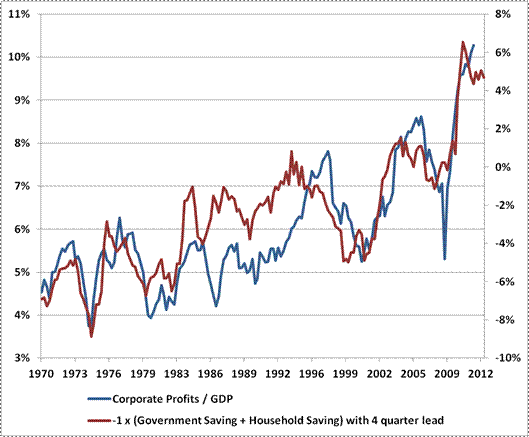
I was pointed to this work by Hussman through Business Insider.

The implication here is that total dissaving is not only strongly correlated with corporate profits, but is directly causative.

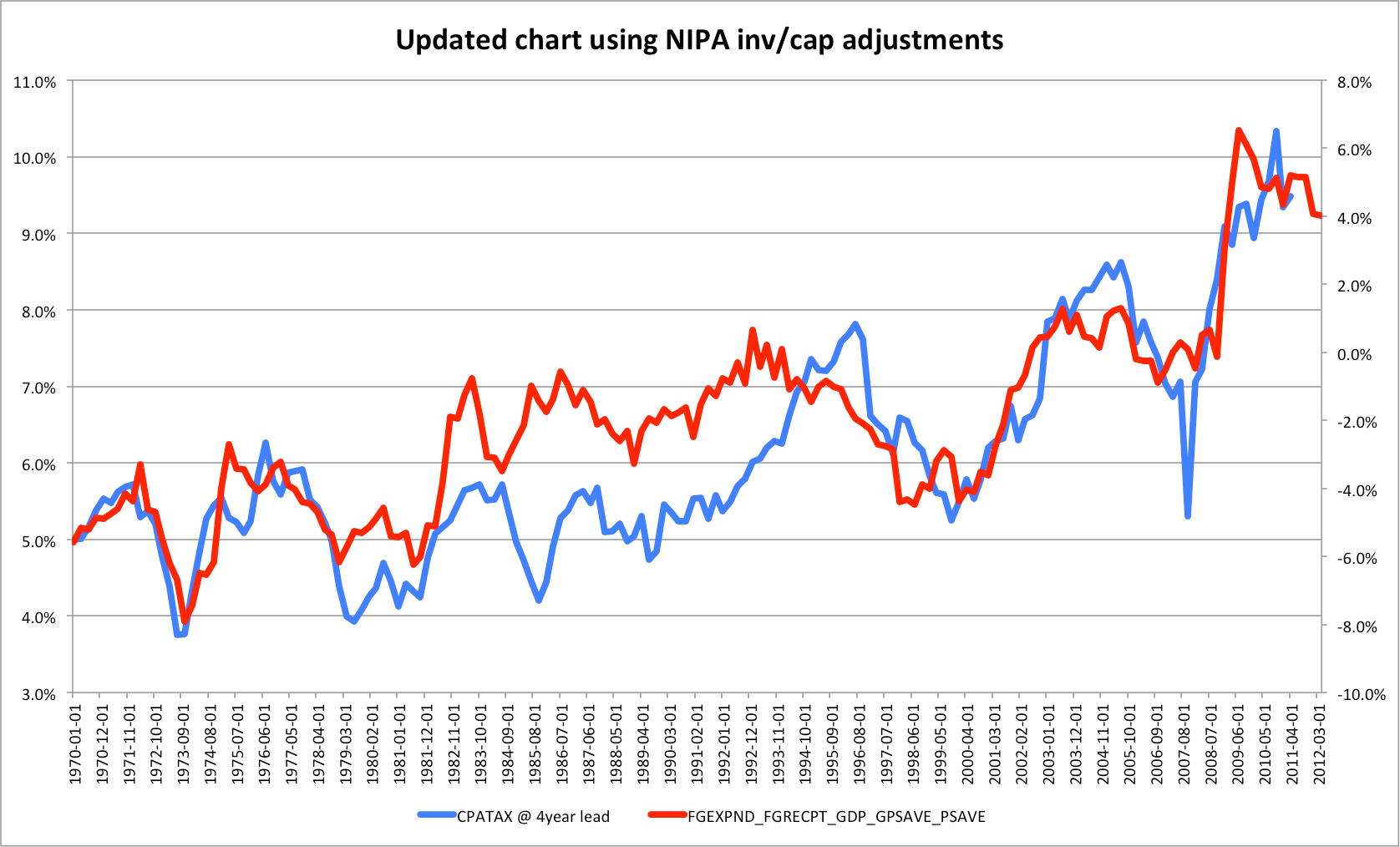
Although he doesn’t fully specify this methods, it’s obvious that Corporate Profits is after-tax corporate profits (including foreign profits) and I was able to approximate his results using this FRED2 link.

Update: I re-charted this using the NIPA corporate profits inventory & capital adjusted data that he clearly used (CPROFIT).  It doesn’t really change the outcome here, but it matches his chart more precisely.

Corporate profits is, in other words, after-tax and including foreign profits.

Savings is approximately personal savings (PSAVE) + the Federal deficit/surplus (FGRECPT-FGEXPND) (multiplied by -1 to match to shape of the profit line)

There are many issues with this analysis